Conflict Resolution and the Declaration of Independence
© 2026 by Bill Eddy, LCSW, Esq.
For this month of the 250th anniversary of the Declaration of Independence I decided I would look back at a little history, sharing my own personal thoughts about it. The Declaration of Independence turns out to have been a team effort that required some conflict resolution skills and some significant compromises. Balancing large personalities was not easy, but with some good skills they managed to jointly produce one of the most important documents ever written – even though it wasn’t perfect.
Writing the Declaration of Independence
We like to think that Thomas Jefferson wrote the Declaration of Independence, but it really was a committee. Apparently, Jefferson was only 33 years old and one of the youngest members of the Continental Congress when it met in the summer of 1776 in Philadelphia. The Revolutionary War was already in progress, having begun in Massachusetts in Lexington and Concord in 1775. The pressure was on to come up with a unifying statement of purpose for the 13 colonies that were rebelling against the British Crown.
On June 11, 1776, the Second Continental Congress appointed Jefferson to a committee, which became known as the Committee of Five, that was tasked with writing a statement declaring independence for all the colonies. The committee included such historical greats as: John Adams, Benjamin Franklin, Roger Sherman of Connecticut, and Robert Livingston of New York. They unanimously chose Jefferson to write the statement.
Ben Franklin was my hero, as I grew up in Philadelphia and admired his scientific brilliance and international conflict resolution skills as perhaps the most important in founding the United States. After all he got France involved which may have made the difference militarily. But he also played a calming and mediating role with resolving the conflicts around creating the Constitution and before that the Declaration of Independence. He was considered the best writer in the Committee of Five, but at 70 years old “he declined to write the draft because, as an old man and a wise man and, above all, a man of many rules, he refused to write anything fated to be edited by committee.” (Lepore, 2026)
If you have ever worked on a committee and drafted a statement to be adopted, you probably know that allowing it to be edited by others can be a painful process for any writer.
Adams, who was very competitive and jealous of Jefferson, “insisted that he’d have written it himself if he hadn’t thought it necessary that a Virginian should write it; also, as the famous Massachusetts curmudgeon admitted, everyone found him ‘obnoxious.’” The other two, Sherman and Livingston, were not even considered as all agreed they were poor writers. This left Jefferson free to write. (Lepore)
While he claims that it only took him two days to write the Declaration, it was 17 days before he submitted his draft to the rest of the committee on June 28. He didn’t do any research to find historical precedent for what they were doing nor did he read books on philosophy or religion to get some guidance. In deciding his approach to writing the Declaration, he believed that he and the rebels were free to develop their own rationale for their independence. British history didn’t matter because they were rejecting Britain. And history in general didn’t matter, because they were creating something totally new. He also didn’t feel the need to state any new original principles for humanity. He told James Madison: ‘I did not consider it as any part of my charge to invent new ideas altogether & to offer no sentiment which had ever been expressed before.” He said it was simply intended to be “an expression of the American mind” and heart and soul. (Lepore)
While it was not research-based, it did reflect the body of knowledge Jefferson had already acquired from a lifetime of reading history and science, and it had a flowery style that he had uniquely developed over the years from many others. It seems that he was unavoidably influenced by some prior writings, such as the Virginia Declaration of Rights which included a phrase based on the writing of the philosopher John Locke: “the enjoyment of life and liberty, with the means of acquiring and possessing property, and pursuing and obtaining happiness and safety.” But he made it much more succinct and memorable. (See below). (JohnLocke.org)
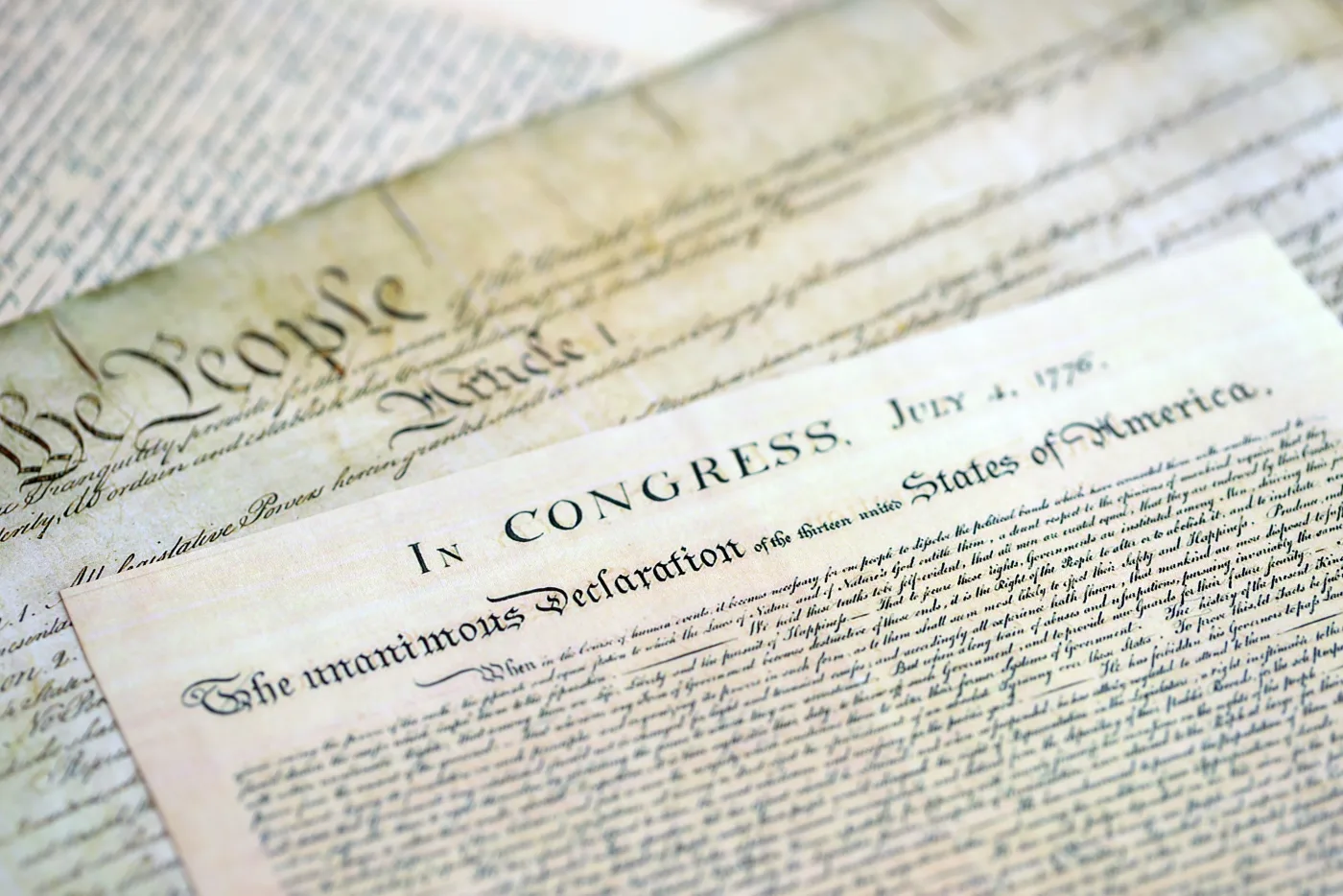
While others argued that it didn’t have an original idea in it and only reflected concepts that the Continental Congress had debated for two years, he did make it sound uniquely powerful. I was in Washington in May and saw an original copy, but it was so faded that I could not easily read it. Here is the beginning of the official text:
“The unanimous Declaration of the thirteen united States of America, When in the Course of human events, it becomes necessary for one people to dissolve the political bands which have connected them with another, and to assume among the powers of the earth, the separate and equal station to which the Laws of Nature and of Nature’s God entitle them, a decent respect to the opinions of mankind requires that they should declare the causes which impel them to the separation.
We hold these truths to be self-evident, that all men are created equal, that they are endowed by their Creator with certain unalienable Rights, that among these are Life, Liberty and the pursuit of Happiness.—That to secure these rights, Governments are instituted among Men, deriving their just powers from the consent of the governed, —That whenever any Form of Government becomes destructive of these ends, it is the Right of the People to alter or to abolish it, and to institute new Government, laying its foundation on such principles and organizing its powers in such form, as to them shall seem most likely to effect their Safety and Happiness.”
When Jefferson finished his draft, he turned it over to Ben Franklin and John Adams, who he most trusted to share their “judgments and amendments.” Franklin apparently came up with “We hold these truths to be self-evident” (instead of “We hold these truths to be sacred & undeniable”). Of course, I agree with Franklin and Jefferson did as well.
Major Edits by Congress
Then it went to the entire Second Continental Congress on July 2nd and 3rd, as a “committee of the whole” for final editing. Here’s where the butchering began, with 86 changes made. Jefferson’s draft was long. Congress took out several hundred words. Some of their minor edits included swapping “neglected utterly” for “utterly neglected” and “a people who mean to be free” for “a free people” and changing the description of the injuries committed by the King from “unremitting” to “repeated.” Apparently he found these edits unbearable, but historians agree that they were good changes. (Lepore)
But the biggest edit was to this paragraph that Jefferson, a wealthy slaveholder, had written into the long list of grievances against King George III, stating that the king had:
“waged cruel war against human nature itself, violating its most sacred rights of life & liberty in the persons of a distant people who never offended him, captivating & carrying them into slavery in another hemisphere, or to incur miserable death in their transportation thither [and with having defeated the colonists’] every legislative attempt to prohibit or to restrain this execrable commerce.” (Lepore)
It seems that Jefferson was ambivalent about slavery, but his wealth had benefitted from it. Years after his wife’s death, he had a substantial relationship with Sally Hemings, an enslaved woman in his household. She negotiated “extraordinary privileges” for herself and freedom for any children she would have with him. He would father six children with her and he eventually freed the four who survived to adulthood. But he never freed any others on his plantation. (Monticello.org)
When Congress eliminated this paragraph, at the urging of South Carolina and Georgia, it does not appear that he fought to keep it. A significant number of the signers of the Declaration were wealthy slaveholders. This compromise got the Declaration approved but left the issue officially unresolved for nearly one hundred years and unofficially full equality still remains an issue.
Conclusion
Overall, one has to hand it to the “Founding Fathers” for negotiating and creating this amazing Declaration. Initially, Thomas Jefferson wrote it, but it was only a draft. Then the Committee of Five was mostly supportive. Then the entire Congress made 86 minor and major changes in only two days, then published it July 4th, 1776.
While it didn’t recognize the rights of enslaved people, native people, women, and generally men without property, it was a good start to a radical concept that continues to drive humanity forward: that all people are created equal and should have rights to life, liberty and the pursuit of happiness. We should be proud of the conflict resolution skills that got this nation started, but also we should be diligent in teaching and learning more skills to achieve these ideals. They showed us it can be done!
Happy 4th of July!
References
Balfour, Brian, “Life, liberty and property,” JohnLocke.org, March 17, 2026. Retrieved on June 24, 2026 from johnlocke.org/life-liberty-and-property.
Declaration of Independence: A Transcription. Retrieved on June 24, 2026 from archives.gov/founding-docs/declaration-transcript.
Lepore, Jill, “What We Hold: The Writing and Meaning of the Declaration of Independence,” The New Yorker, May 11, 2026.
“Slavery at Monticello.” Retrieved on June 24, 2026 from monticello.org.
Bill Eddy, LCSW, Esq., is the Director of Innovation for the High Conflict Institute and the lead author of Mediating High Conflict Disputes.